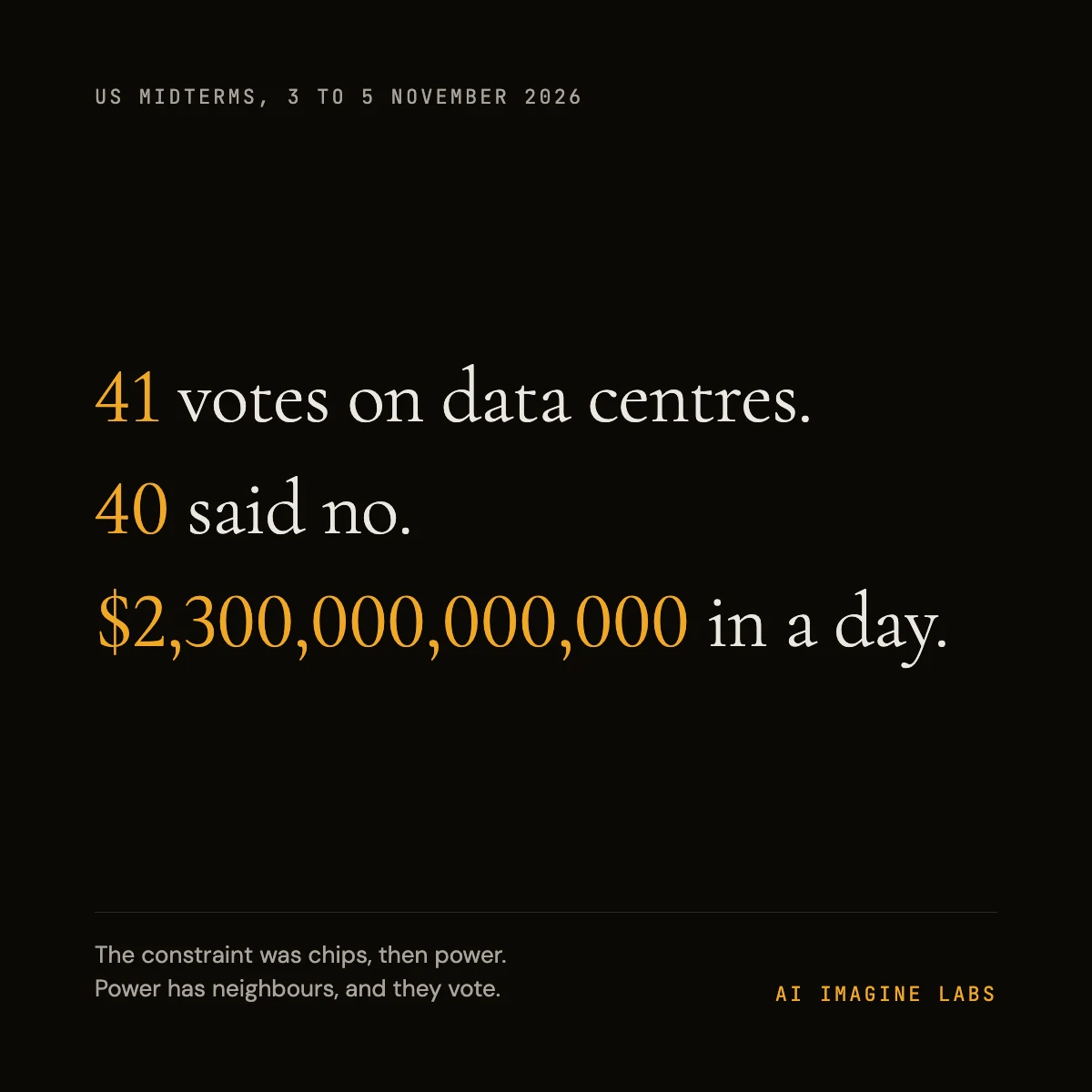
Last Tuesday, voters in ten US states decided 41 times whether a data centre could move in next door. Forty times they said no.
Exit polls put it at 76 percent against a data centre in their own community. The industry had spent 79 million dollars on the election. Its biggest general-election bet, a Senate candidate in South Carolina, lost to an opponent who called her Data Center Darline. You cannot buy your way out of a nickname.
On Thursday the Nasdaq 100 lost 2.3 trillion dollars, more than it has ever lost in a day. Traders told Bloomberg the vote had spooked them. AMD had just reported the best quarter in its history. It shed 17 percent anyway. The chips had not changed. The zoning had.
Two days after the vote, OpenAI published a Community Compact for the campuses it will own. No NDAs with public officials. Noise studies before the servers switch on. Residents will not pay for the power. It reads like a list of everything the neighbours just voted for.
I have seen enough plans that assumed the permit. The slide said community engagement and meant a press release. For four years I told boardrooms the constraint on AI would be chips, then power. Nearly. Power has neighbours, and the neighbours vote.
Why it's Material. A risk story. The build-out was priced as a supply problem. It just became a consent problem.
The Monday move. Find the line in your AI plan that assumes somebody else's yes: a utility, a council, a landlord, a town. Ask when anyone last asked them. If the answer is never, you have a wish.
Monday Morning Mashup No. 145. What moved in AI, every Monday.